
When it comes to office-based surgery (OBS), the first question on every ophthalmologist’s mind is,...
2025 has been a transformative period for ophthalmic care, with office-based surgery (OBS) moving to the forefront of the industry. Increased adoption, rigorous safety outcomes, and growing patient demand have all accelerated the shift toward OBS. In this year-end review, we reflect on the milestones achieved, the challenges faced, and the solutions shaping the future of eye care.
Office-Based Surgery Growth
The continued expansion of ophthalmic OBS is driven by technological advancements, proven safety profiles, economic pressures, and evolving patient expectations. According to the 2025 ASCRS Clinical Survey, 6% of surgeons perform surgery in an OBS suite – a notable increase from 2% the previous year.
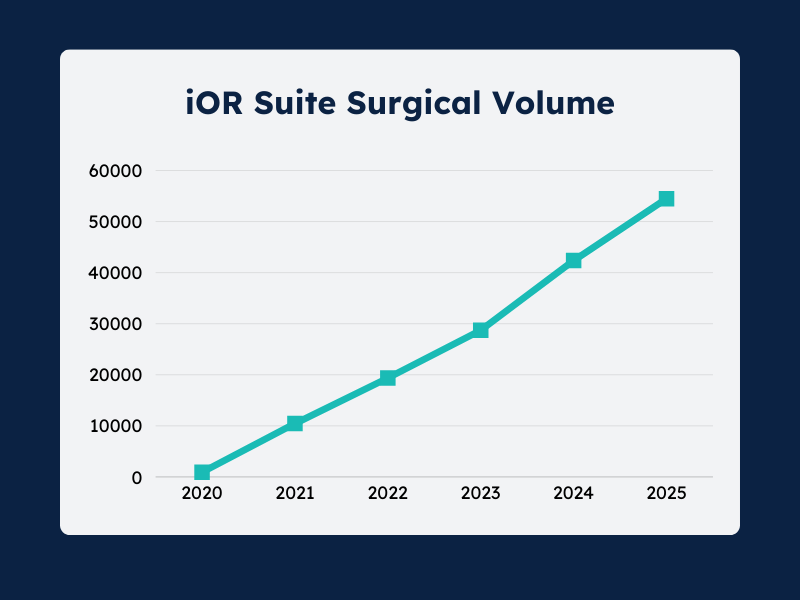
iOR Suites have expanded to nearly 40 states and territories plus Europe and the Grand Cayman Islands. In addition, our existing practice partners continue to grow their OBS case volume year-over-year.
OBS Safety Outcomes
As part of our accreditation program, iOR Partners gathers comprehensive data on procedures performed in iOR surgical Suites®. Quarterly occurrence data from surgeries conducted across multiple centers and utilizing various techniques consistently demonstrates that our safety outcomes meet or surpass those of other outpatient settings.
| iOR Data 109,694 procedures updated September 2025 |
|
| Endophthalmitis | 0.017% |
| Unplanned Vitrectomy | 0.224% |
| Return to the OR |
0.047% |
| TASS or Significant Iritis | 0.040% |
| Referred to Hospital |
0.003% |
Industry Challenges in 2025
The eyecare landscape is facing disruptive challenges. From access to care and declining reimbursements to the rise of corporate consolidation, these issues are causing us to rethink how care is delivered and accessed. For eye care professionals, these challenges demand innovative solutions and proactive strategies to ensure both practice sustainability and patient experience remain at the forefront.
- Patient Demand and Access to Care: With 37 million people entering Medicare by 2030 and a declining number of eye care providers, a significant care gap is emerging. Factoring in the shortage of anesthesia providers, this gap widens and costs rise. Furthermore, fragmented co-management systems disrupt patient flow, leading to missed diagnoses and suboptimal long-term outcomes.
- Declining Reimbursements: With an 11% reduction in the Medicare Physician Fee Schedule for cataract surgery in 2026, relying on third-party payers is becoming unsustainable. We must build a stronger cash-based, refractive surgery market to ensure financial stability and continue providing care for all patients.
- Shifting Patient Demographics: Optometrists manage 85% of all patient visits, including the prime 18-55 demographic ideal for refractive surgery. The traditional co-management system has failed to effectively bridge this gap. Ophthalmologists need a direct, ethical, and profitable pathway to these patients without compromising the MD's authority.
- Corporate Consolidation: Retail-oriented corporations are aggressively entering the surgical space, acquiring practices and entire hospital systems to control the surgical market. If independent physicians do not get ahead of this, they risk becoming employees of large retail corporations.
Financial Stability and Growth for OBS Practices
iOR Partners pioneered the OBS movement creating a path to physician-led care that is safe, efficient, and more accessible. While that vision remains, the challenges mentioned above have required a reimagined approach. This has led to a groundbreaking collaboration model that brings together ophthalmologists (MDs) and optometrists (ODs) – a first-of-its-kind partnership that benefits both patients and providers.
Earlier this year, Legacy Eyecare and Kugler Vision in Omaha, NE were the first to embark in this MD/OD OBS model which breaks down traditional barriers, offering:
- For ODs: new revenue streams, patient retention, and more cohesive care delivery.
- For Surgeons: increased surgical volume, a steady referral pipeline, and full medical control and accountability of procedures.
- For Patients: a seamless, patient-centered experience without the compartmentalization of typical referral pathways.
Following this success, a second collaborative suite has opened in the Kansas City area with Ridgeview Eye Care and Durrie Vision and several others are in the works for 2026.
OBS Top News Stories
The industry is taking notice. Here are the top headlines featuring OBS this year:
- Retina Today: The Feasibility of Vitrectomy in the Office-Based OR
- Ophthalmology Times: ASCRS 2025: Mark Lobanoff, MD, on making the move to office-based surgery
- Retina Rounds: 105. Podcast # 15: Interview with Omar Shakir, MD, MBA
- Review of Ophthalmology: The good, the bad, and the office-based surgery
- Retinal Physician: Bringing Retina Surgery into the Office
- Review of Optometry: The evolution of office-based surgery unlocks immense opportunities
- Review of Optometric Business: The Changes in Our OD-MD Practice That Yielded 35% More Revenue
- Ophthalmology Management: From OBS Mess to Success
- CRST: Office-Based Surgery
- AAO Press Release: Future of Cataract Surgery May be Back at the Office
- Modern Retina: The Retina TL;DR: Redefining office-based surgery for retina care with Jonathan Feistmann, MD
- Eyes on Eyecare: iOR Partners launches MD-OD surgery partnership model
- EyeWorld: Opening the door to office-based cataract surgery: considerations and comparisons
Final Wrap Up
2025 has been a year of remarkable progress for OBS, marked by expanded adoption, proven safety outcomes, and innovative partnerships that are redefining the delivery of ophthalmic care. Despite industry challenges, the resilience and ingenuity of the eyecare community have paved the way for sustainable growth and improved patient experiences. As we look ahead to 2026, the momentum behind OBS continues to build, promising even greater advancements and opportunities. Together, we’re not just adapting to change—we’re leading it. Here’s to another year of innovation and success!